A Practical Framework for Building Wealth
A long-term, realistic framework for individual investors that balances index funds, selective stock picking, and discipline over decades.
Most people begin investing by asking, "Which stock should I buy?" It feels logical, actionable, and intelligent. Unfortunately, this is where many journeys quietly go wrong.
Wealth is rarely built by a single brilliant decision. It is built through a repeatable process that survives mistakes, market cycles, and real life.
This note explains:
- The main paths people use to build wealth
- Why some paths worked historically but struggle today
- A framework that balances safety, learning, and long-term growth
- Practical rules individuals can realistically follow for decades
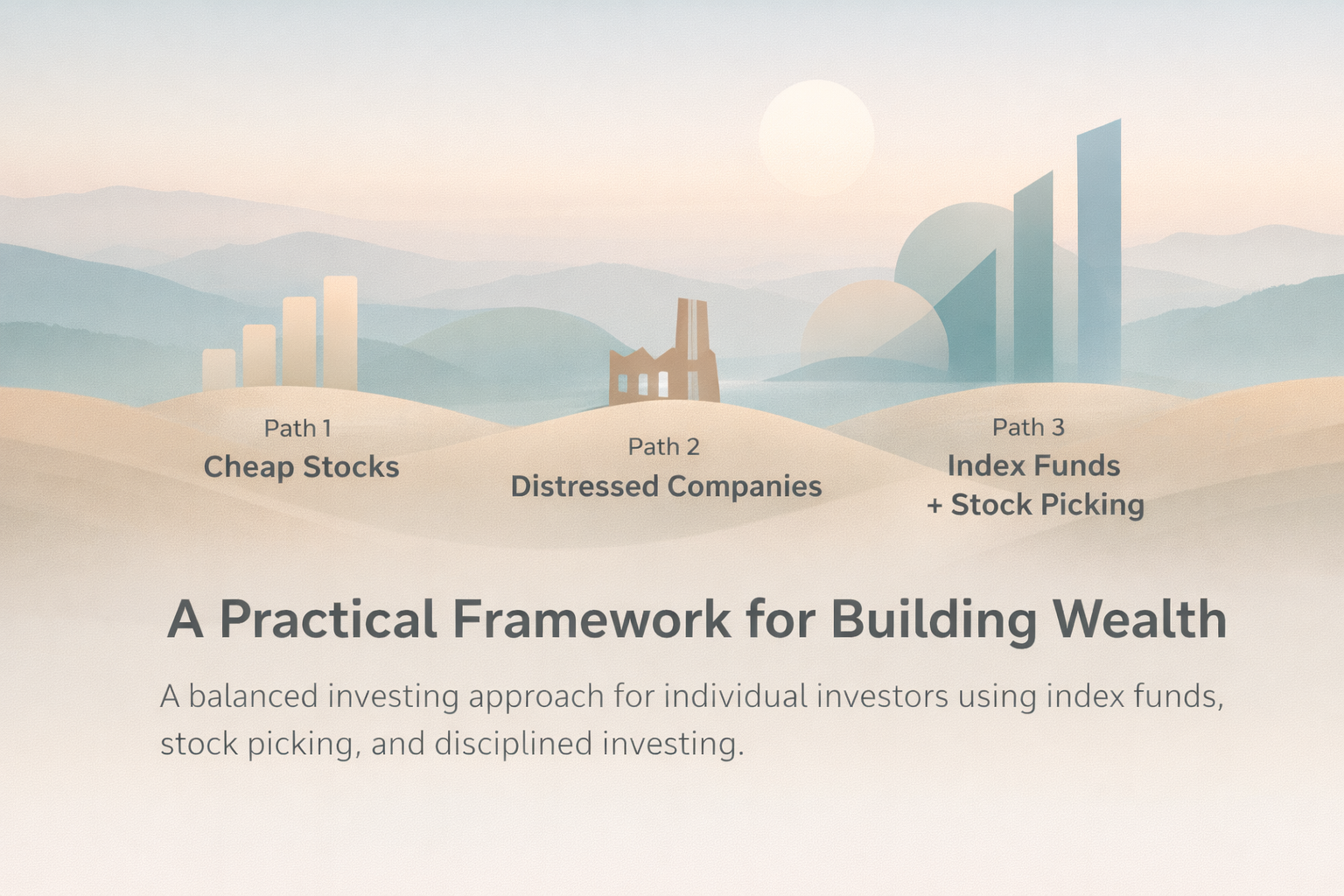
1. The three main paths to wealth
Path 1: Buying "cheap" stocks (classic value investing)
This approach focuses on buying companies trading below their perceived intrinsic value and waiting for the market to correct the mispricing.
Why it worked historically:
- Information was limited and slow-moving.
- Fewer analysts covered companies.
- Individual investors could discover opportunities before institutions.
Why it is difficult today:
- Financial information is instantly available worldwide.
- Thousands of professional investors and algorithms scan continuously.
- Obvious mispricing disappears quickly.
Value investing is not dead, but it is no longer a reliable edge for most individual investors.
Path 2: Buying strong businesses in distress
This approach involves identifying fundamentally strong companies facing temporary problems and buying during periods of fear.
Why it works:
- Fear often causes overreaction.
- Fundamentals tend to reassert themselves over time.
Why it is hard:
- True temporary distress is rare.
- It is easy to confuse decline with disruption.
- It requires patience and emotional resilience.
This path can work, but opportunities are infrequent and mistakes are costly.
Path 3: Index funds combined with high-quality businesses
This approach uses index funds for broad market exposure while selectively investing in businesses that can compound faster than the market.
Why it works:
- Index funds capture overall economic growth.
- High-quality businesses benefit from scale, margins, and durable demand.
- It combines stability with long-term upside.
For most individuals, this is the most practical and repeatable path.
2. Why index funds are the foundation
Index funds are not a compromise. They are a rational default.
What index funds do well:
- Diversification across industries and companies.
- Low fees and minimal effort.
- Historically strong long-term returns.
Over long periods, steady investing in index funds has turned regular savings into meaningful wealth.
The limitation: If income is average, index funds alone may not create rapid wealth acceleration. They build stability and protect against large mistakes, but may not maximize upside. This is why index funds should be viewed as the foundation, not the ceiling.
3. Learning before stock picking
Stock picking without basic understanding often turns into speculation. Before selecting individual stocks, investors should understand:
- How margins reflect pricing power.
- Why institutional ownership matters.
- What economic moats protect a business.
- How valuation metrics like P/E work.
- Why debt levels affect survivability.
The goal is not perfection. The goal is reducing ignorance before increasing concentration.
4. The hidden risk of over-diversification
Owning too many stocks feels safe, but often creates a different risk.
If you own many stocks:
- You dilute your winners.
- You cannot track businesses deeply.
- You replicate mutual fund behavior without their advantages.
Mutual funds and ETFs:
- Have teams of analysts.
- Operate under regulatory constraints.
- Benefit from scale and access.
Individuals have one advantage: focus. If you want index-like behavior, buying the index is more efficient.
5. A portfolio framework that scales
Year 1: Build the base
- Invest primarily in index funds.
- Use dollar-cost averaging.
- Focus on staying invested through volatility.
After year 1: Introduce stock selection
- Start from trusted index constituents.
- Filter down to a manageable number of businesses.
Portfolio size guidelines:
- Under $1M: 5 core + 5 experimental stocks
- $1M to $5M: 10 core + 5 experimental stocks
- Over $5M: 15 core + 5 experimental stocks
Never exceed 20 holdings. Experimental positions are investments where conviction is still forming.
6. Replace, do not add
Every new stock should replace an existing one. This forces:
- Comparison rather than accumulation.
- Awareness of opportunity cost.
- Discipline in capital allocation.
Treat each stock like a business you own. If a new business deserves capital, it must be better than one you already run. Capital should be rotated gradually, not emotionally.
7. Why this approach works
This framework works because it aligns with human behavior.
- It allows learning without catastrophic loss.
- It builds conviction gradually.
- It avoids forced decisions.
- It keeps investors invested through uncertainty.
Wealth is built not by brilliance, but by consistency and survival.
The one idea to remember
Diversification protects you from ignorance. Concentration creates wealth once ignorance is reduced. Index funds do the first job. Selective stock picking does the second.